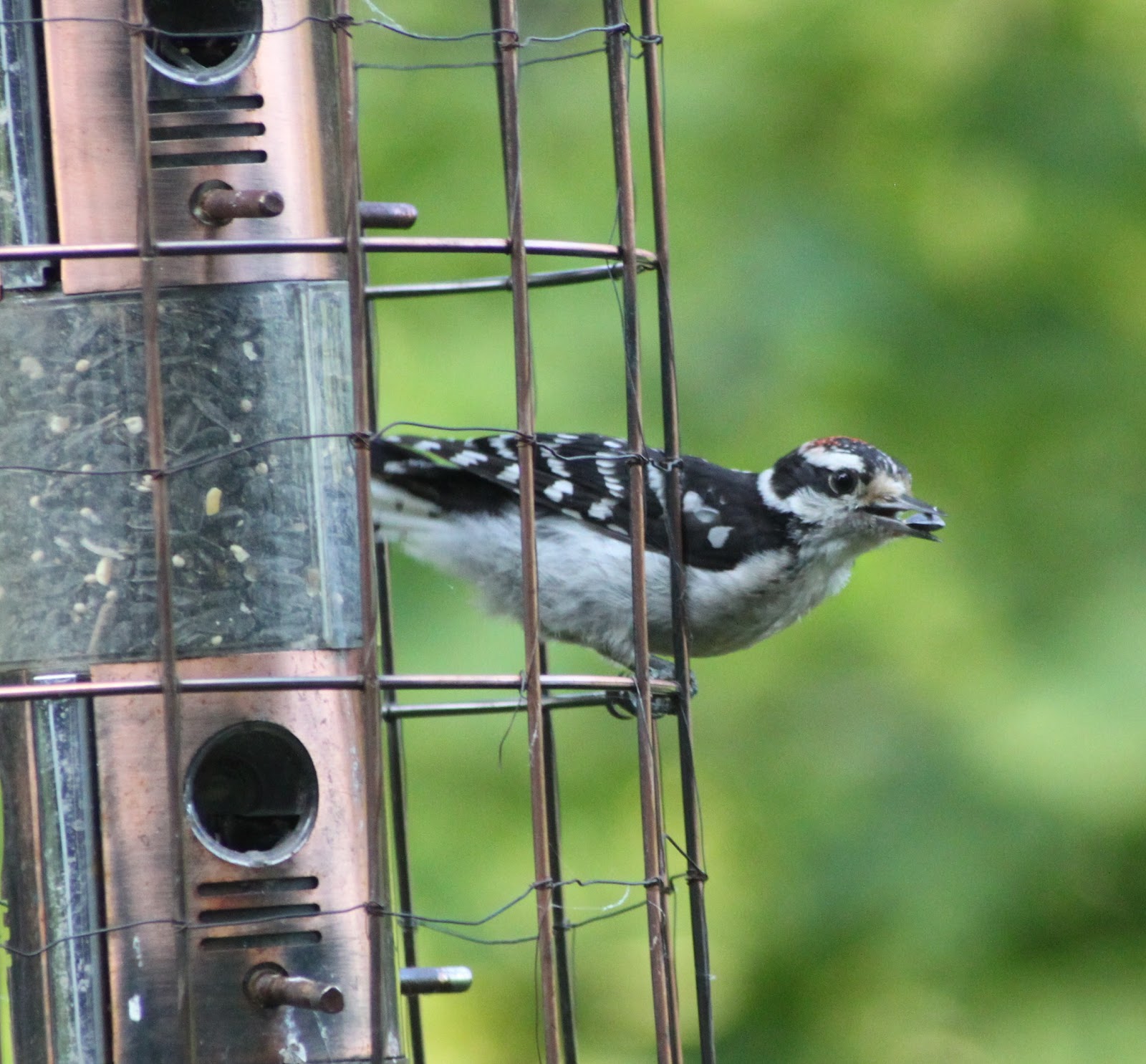
For a while (about one month I'd say) the activity at the bird feeders dropped drastically. Only house sparrows were constant visitors taking endless trips to feed their babies. Mourning Doves were constant as well, but everyone else seemed to move on or switch to eating bugs and worms.
Lately the house (and maybe some purple) finches have been feeding here on a regular basis. Lots and lots of them! I'd say about 5 males and 20 females and/or juveniles! Yesterday there were 7 goldfinches - all males - at the bird bath! I believe I saw an oriole chase a crow last Sunday.
Today I saw a downy woodpecker at the back feeder, a nuthatch at the front feeder, red winged blackbirds on the ground below the large feeder in the enclosed garden, and a red bellied woodpecker on top of one of the cedar posts. Other visitors to the garden and feeders today were grackles, black birds, blue jays, cardinals, catbirds and robins.
And I saw a cotton tail bunny out back by the sour wood tree! It is so cute and tiny!! Saw it or another one last night too.
June 5, 2012
May 12, 2012
Mockingbird, Turkey and Snowy Egret Sightings
Finally spotted a mockingbird here. There have been mockingbirds in the neighborhood at work (Bridgeport) for a few weeks now. Or at least I believe they are by their singing. I haven't heard or seen one here at home until today.
Also spotted a lone female turkey walking across the field and a snowy egret wading the the pond!
May 9, 2012
Wrens and Catbirds Are Here
Got back from Nashville last night. This morning saw that the wrens are here now. They (or he) are/is building a nest in the new house that Bob built for them and hung up last month. I also see that the catbirds have arrived. They are perched in the viburnum beneath the leaves, giving them great privacy and protection. I wonder if they are building a nest in there.
May 1, 2012
Cocoon Identified
The cocoon I discovered last fall, hanging from a branch of a hazelnut hung on all winter. I came across it again the other day and finally remembered to do some research to see what type of creature made it. I believe it is the cocoon of a Promethea or Polyphemus Moth. Both are in the silk moth family. I do have a dead, ragged specimen of one of these moths found here a few years ago.
I'm really intrigued by how the leaf is wrapped with silk to form the cocoon. It looks like an embossed pattern. It is also impressive how it has survived this long. When I first came across it late last fall, it already had the opening on top, so I am not sure when the moth emerged. I hope this summer and fall will bring new opportunities to see a cocoon in the construction stages.
April 23, 2012
Cedar Apple Rust
I went outside after the rain with my camera to capture water droplets on leaves. I really enjoy taking photographs when the weather is overcast. The lack of sunshine enables colors to be more distinct and vibrant. I caught a splash of bright orange within the stand of junipers from the corner of my eye. A closer inspection revealed an intriguing, unusually shaped and rarely seen organism that I had only read about - Cedar Apple Rust.
This fungus needs two host plants in order to live. On this native juniper, Juniperus viginiana, it has produced this very showy gall. (It looks a bit like a sea anemone or sea urchin.) It also needs an apple or crabapple tree near by to finish its life cycle.
April 19, 2012
White Throated Sparrow
Today I saw and identified a white throated sparrow. It is the first time I have ever seen one. It has two little patches of yellow on the top of it's head, in addition to a white throat and black and white stripes on its head.
April 16, 2012
Where Are the Birds?
We had an early start to spring which means an early season of hatching and growth of insects as well as plants. The robins were here in numbers early, as were the phoebes, and many of the winter visitors to feeders must be concentrating on the insects for food. I haven't seen a titmouse, nuthatch, woodpecker or flicker in weeks and a single chickadee appears once in a while. The house sparrows and house finches are still regulars though. I haven't seen the juncos in a few days, so I guess they finally headed north. But I am still waiting for the arrival of the wrens, cat birds, mockingbirds and Baltimore oriole.
Subscribe to:
Posts (Atom)